PISA 2025: what the numbers tell us (and what they don't)
The OECD has just published the worst reading and mathematics result in its history. I read it with a cool head and write what I actually think — which turns out to be more than I expected.
Every three years the OECD drops a report nobody wants to read in August and everybody talks about in September. This time was no different: PISA 2025 came out on 8 September and the headlines repeated themselves to exhaustion. Historic lows in reading and maths, historic highs in hand-wringing.
But underneath the noise there are things worth looking at calmly. Especially if, like me, you spend your days designing training programmes and deciding where to put technology — and where not to.
The numbers that matter
760,000 students, 91 countries, 33 million young people represented. OECD averages have fallen 28 points in reading since 2015 — more than a full school year lost — and 22 in mathematics. Science held up better, with a modest 7-point drop over the decade.
What weighs on me most isn’t the average — it’s the tail. One in five OECD students is now a low performer in all three subjects. In 2022 it was one in six. Including students PISA doesn’t cover, the figure climbs to 29 %. We’re not talking about differential calculus. We’re talking about not understanding a utility bill, not being able to compare prices at the supermarket, getting lost on a simple text. After nine or ten years of schooling. In rich countries.
My reading of the causes
What convinces me about the report is that it doesn’t blame the pandemic. It says the decline started before and has accelerated. If I had to draw it on a whiteboard, I’d sum it up in four moves.
Screens. We’ve spent a decade saying technology would democratise learning, and the data is starting to say the opposite: more screen time, less reading for pleasure, less ability to sustain attention. The countries with the steepest reading drops are also the ones where leisure reading fell the most. Correlation, not causation — but the coincidence is too clean to ignore.
Hasty reading. PISA coins a term I find perfect: hasty reading. Between 2018 and 2025 the share of students who answer quickly and incorrectly has nearly doubled. They struggle to integrate information from multiple sources, to stay with a text for ten minutes. I see it in my own teams, so I’m not remotely surprised to see it in data from 91 countries.
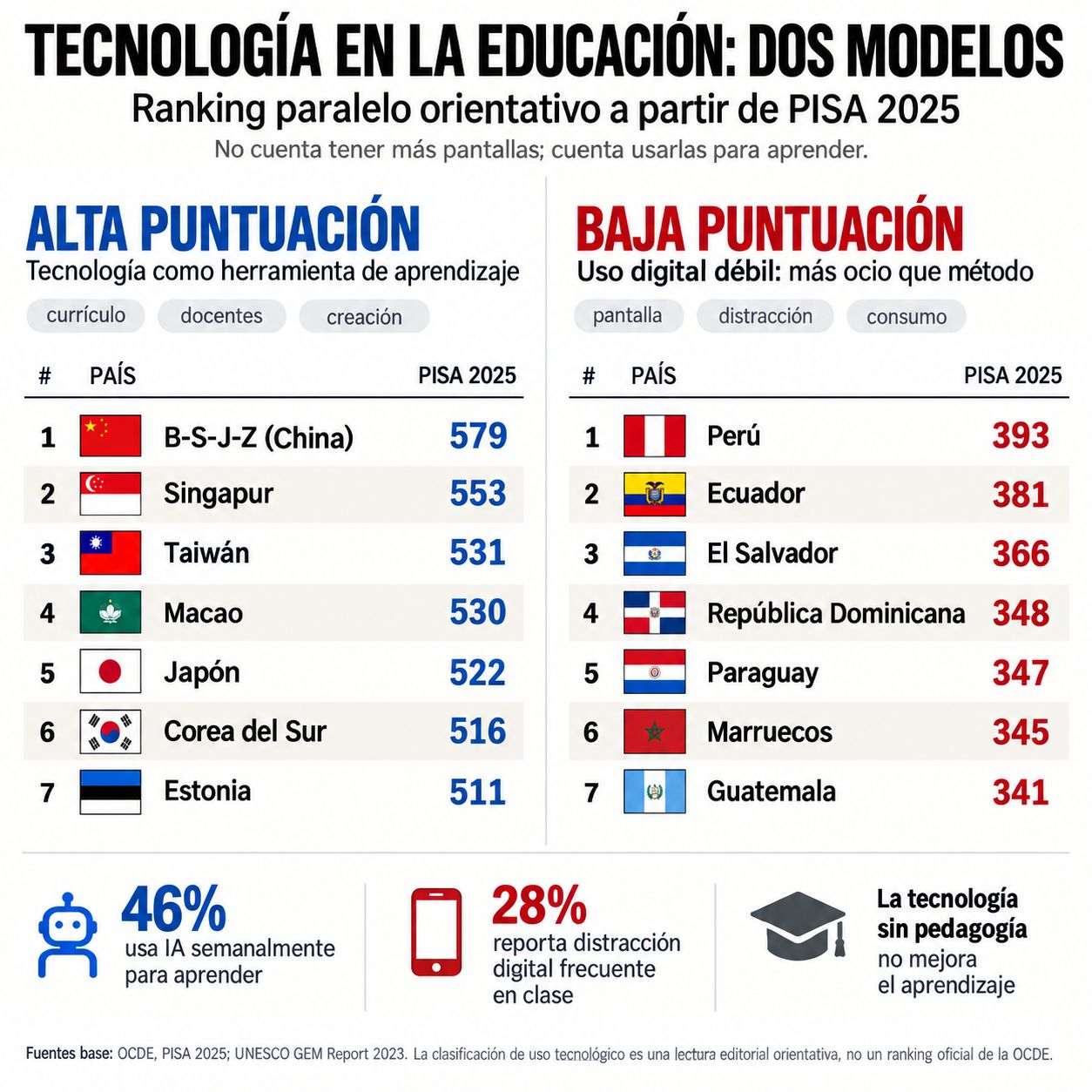
Sanctioned distraction. 28 % of students say their classmates are distracted by phones in most or every class. This is no longer the student’s problem: it’s the system’s.
Absent pedagogy. The systems that fail are the ones that haven’t explicitly taught students how to evaluate digital information or how to use AI critically. They didn’t ban the tool — they left students alone in front of it.
The AI paradox (and why it hits close to home)
PISA 2025 introduces, for the first time, a module on generative AI in the classroom. The most-shared finding: higher-performing students are the ones who use chatbots least. Those who use them to summarise, research or draft score, on average, 20 points lower than non-users. One year of schooling.
But the headline hides something more interesting. Among students who do use AI, those explicitly taught to evaluate the quality of the output perform better. And moderate users — once or twice a week, with a clear purpose — perform at similar levels to non-users.
This matches what I’ve been seeing for a year and a half on real projects: AI is neither good nor bad by nature. It’s good when it protects the student’s cognitive effort, and bad when it replaces it. A scaffold you remove when the building stands, not one that holds the student up forever.
What worries me especially is the breach that’s coming. Socio-economically advantaged students have more opportunities to learn how to evaluate AI critically. Without intervention, we’re about to open a new line of inequality — harder to close than the last.
What works, according to the data
In the systems holding up best — Singapore, China, Japan, Korea, Estonia, the UK — three patterns repeat: narrow but deep curricula, teachers trained in digital pedagogy, and a clear purpose for each technology. PISA draws a U-curve: performance rises with digital use up to about five hours a day; beyond that, it falls.
And one surprise from the new computational problem-solving module: 64 % of OECD students reach the proficient level, but only half combine that with basic competence in science, reading and mathematics. Both, or nothing. Handling a tool well without understanding the foundations is not competence — it’s surface fluency.
What I take from all this
I work with teams and lead transformation portfolios. Three ideas that aren’t from a manual.
The tool doesn’t replace the method. Dropping ChatGPT into a programme without rethinking assessment is decorating failure. The question isn’t which AI do we use, but which cognitive task are we protecting. If the answer is “none”, AI is redundant.
Distraction is designed, not preached. If 28 % of students are distracted in class, it’s a design problem. Screen-free sessions, differentiated spaces, clear policies — not tepid recommendations.
Equity comes before access. We’ve spent years talking about the digital divide as if it were about devices. PISA 2025 says the next divide is about judgement: knowing how to ask, how to cross-check, how to tell when the AI’s answer isn’t reliable. You don’t install that with a tablet.
And to avoid defeatism: Qatar, Brunei, Cambodia, the Philippines and Zambia all improved in reading between 2018 and 2025. They started from the bottom. But they went up. What changes isn’t geography or genetics — it’s education policy. The decline isn’t gravity. It’s a decision.
Ideas that are never examined are not ideas: they are habits. And a good PISA, read without rushing, is still one of the few examinations we subject ourselves to as a society about what actually matters.